Work moves from a plain-language requirement to a merged commit through a fixed sequence of stations. Each is a state machine: state changes only through a validated transition that is saved atomically and recorded as it happens.
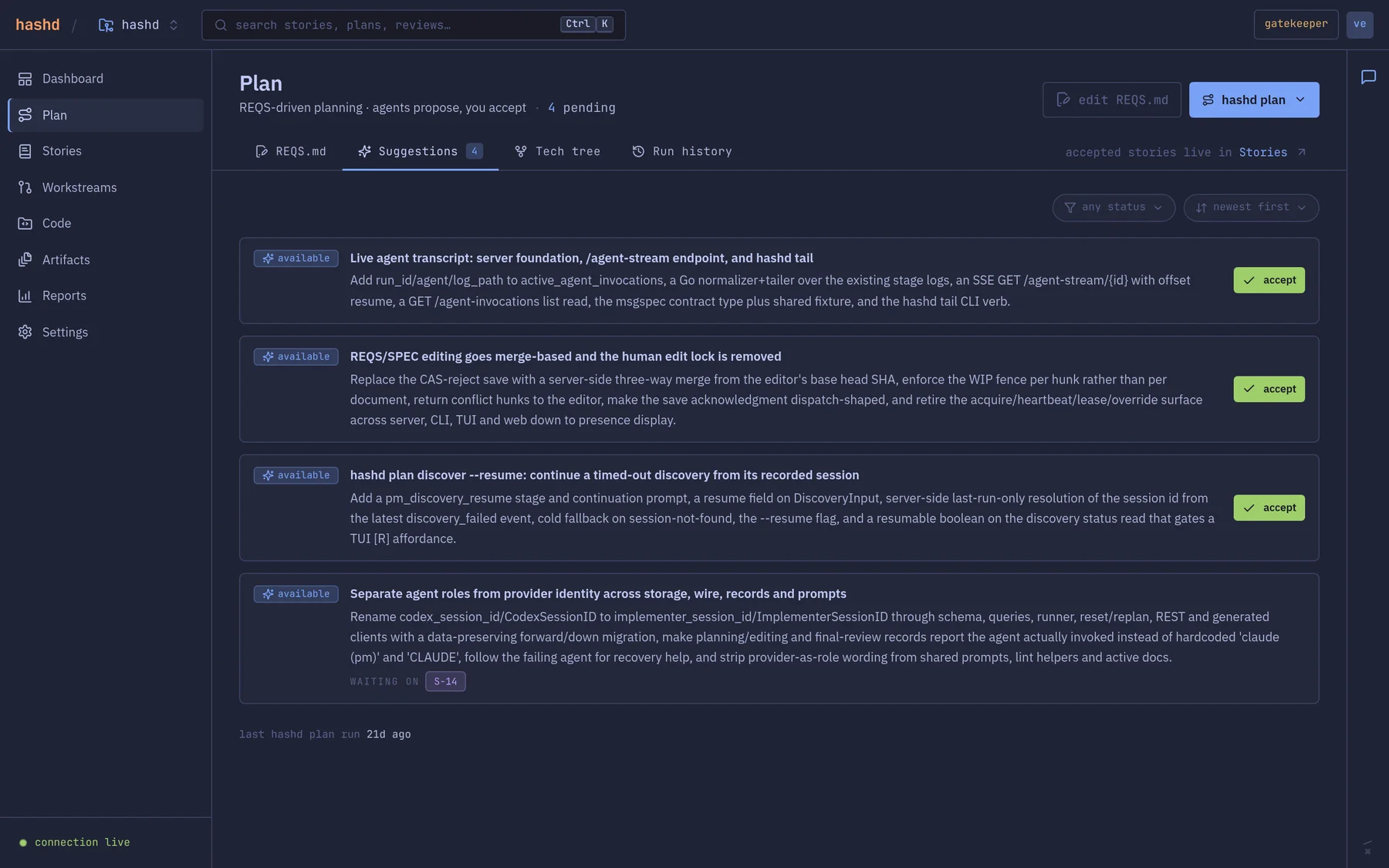
Write requirements in plain language. Discovery reads them alongside the codebase and proposes work that is safe to start against the current main, including what each piece is waiting on.
Prefer to skip discovery? hashd plan story "..." and hashd plan bug "..." create a story directly. Connectors bring in GitHub, Jira, Azure Boards and ClickUp items.
/ui/plan/hashd
02 · Story
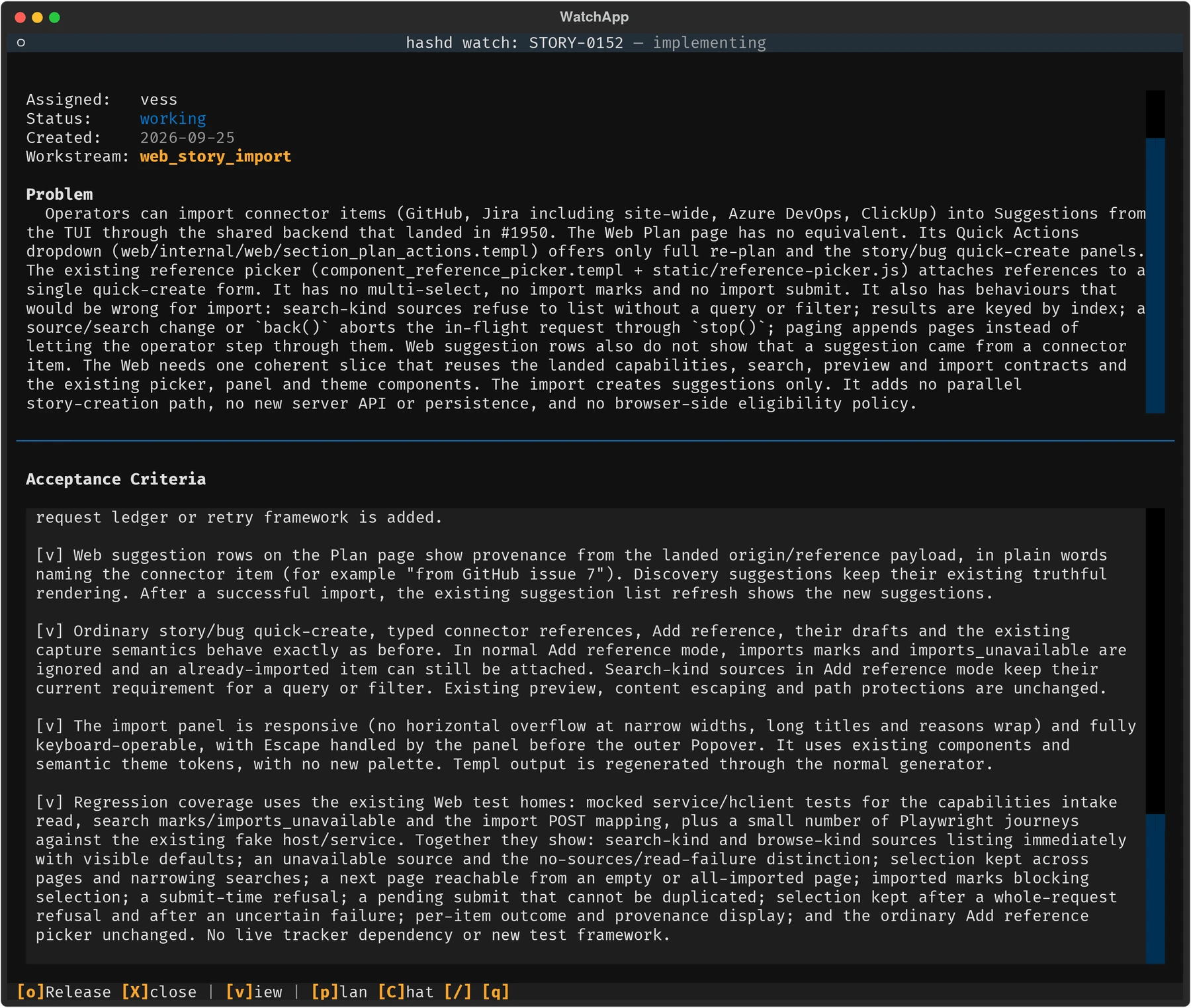
The story is the contract.
A story holds the problem statement and the acceptance criteria: the testable definition of done. Edit, descope or rescope individual criteria, or hand the story to the AI editor, then accept it.
When an agent needs information to proceed, it raises a clarification and the work waits for a person to answer, instead of guessing.
03 · Build
Small commits, each one gated.
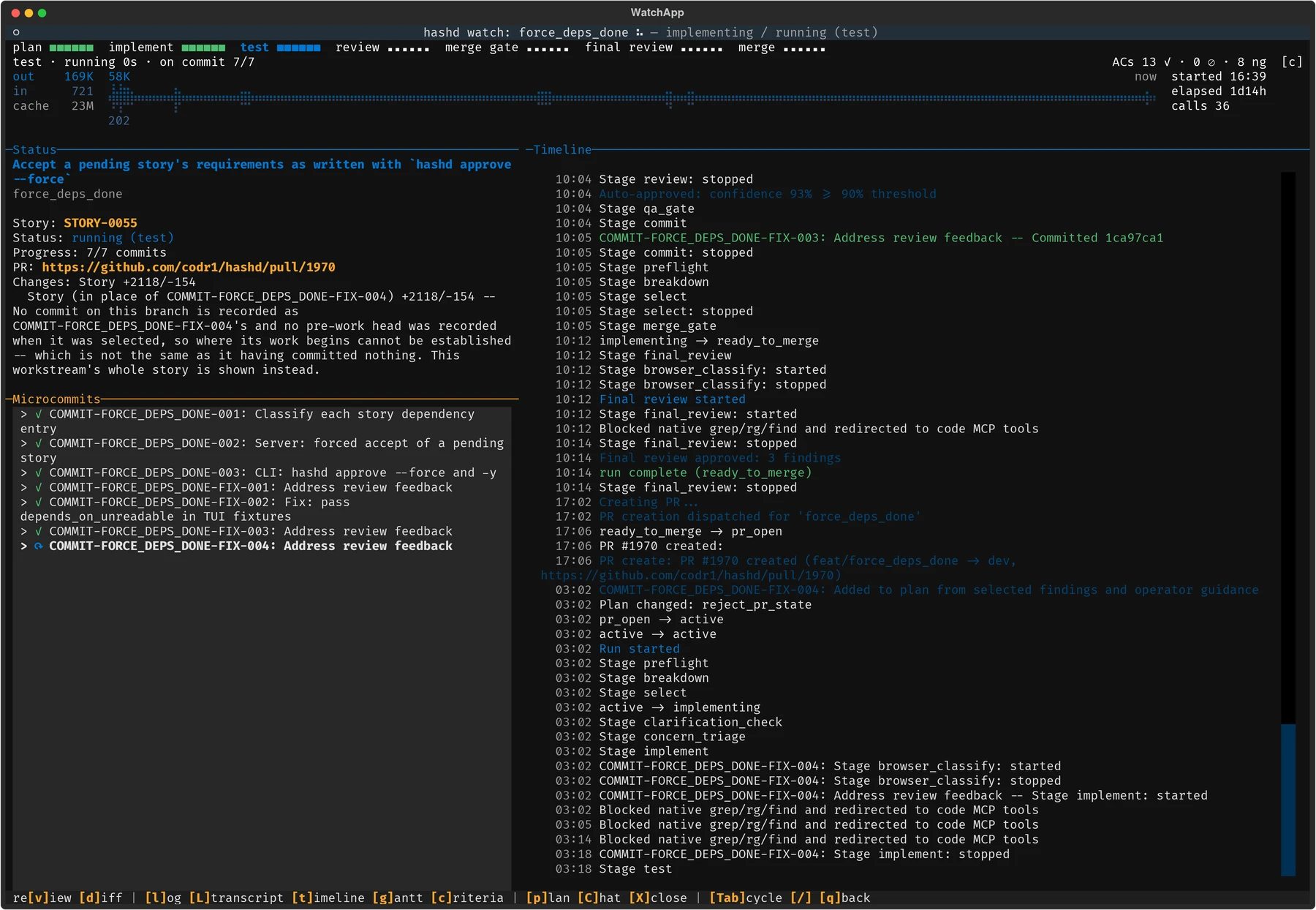
Running a story creates a workstream: one branch in one isolated git worktree, with a plan of micro-commits. Each one runs the same loop, and a commit only lands when every step passes.
Implement
The coding agent writes the change in the workstream's own worktree.
Test
Your configured tests must pass. A red suite goes back to the agent with the failures.
Review
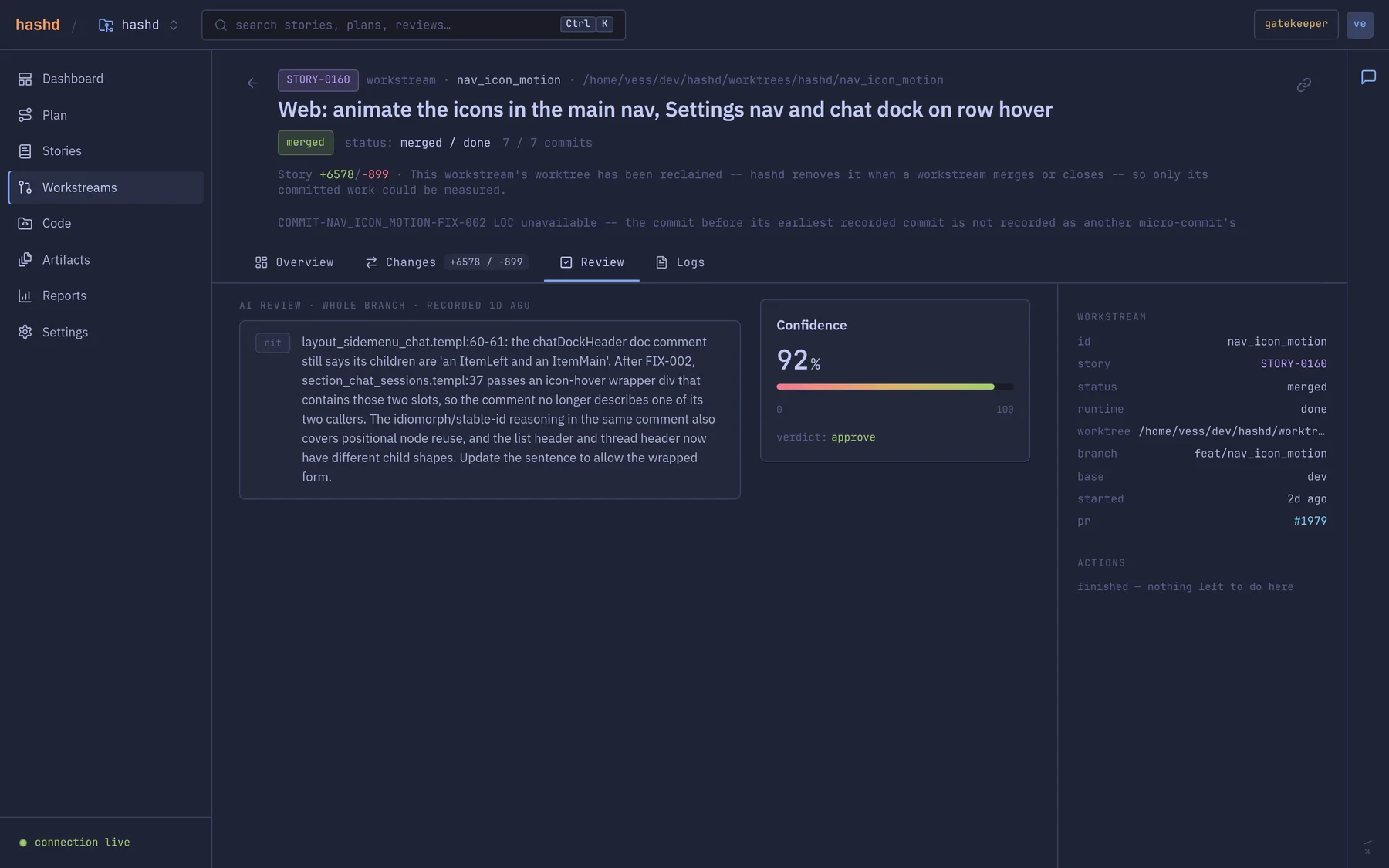
An AI reviewer returns a structured verdict: decision, confidence, blockers and concerns.
Gate
Depending on the autonomy mode, a confident review continues or a person approves.
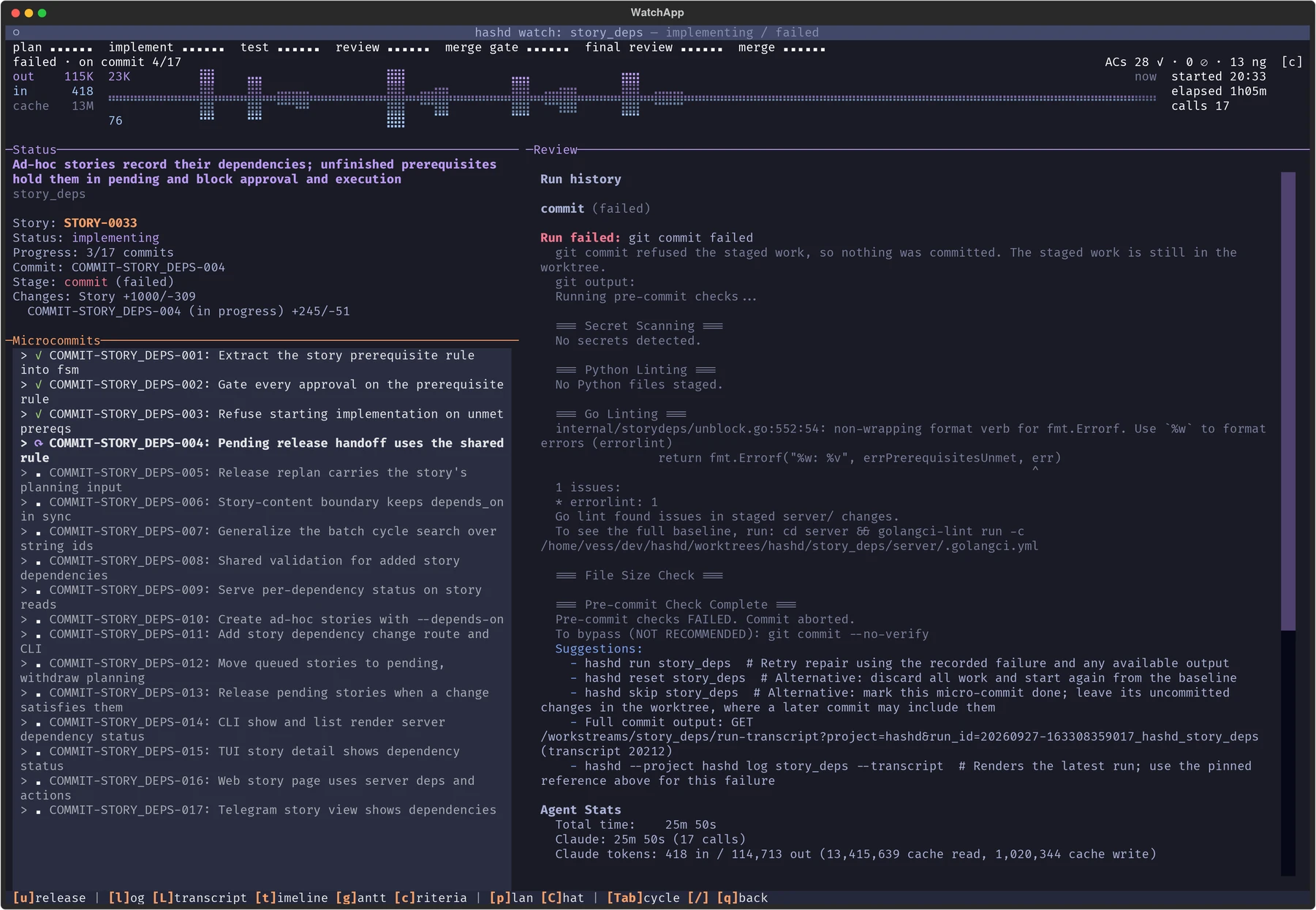
When things go wrong
No infinite loops. No silent failures.
Bounded retriesEach micro-commit gets up to five implement, test and review attempts before it goes to a person.
A judge, not another blind retryA test that was green and turns red goes to a read-only judge that rules whether the change or the test is wrong. Only that ruling can authorize changing a test.
Oscillation detectionWhen the same failures repeat, hashd stops looping and escalates: first to a partial re-plan, then to a person.
A reason and a next stepEvery failure is recorded with its cause and the exact commands to retry, reset or skip.
04 · Final review and merge
The whole branch, then the gate.
Per-commit gates protect each change. Before anything lands, two more gates look at the branch as a whole.
Final review
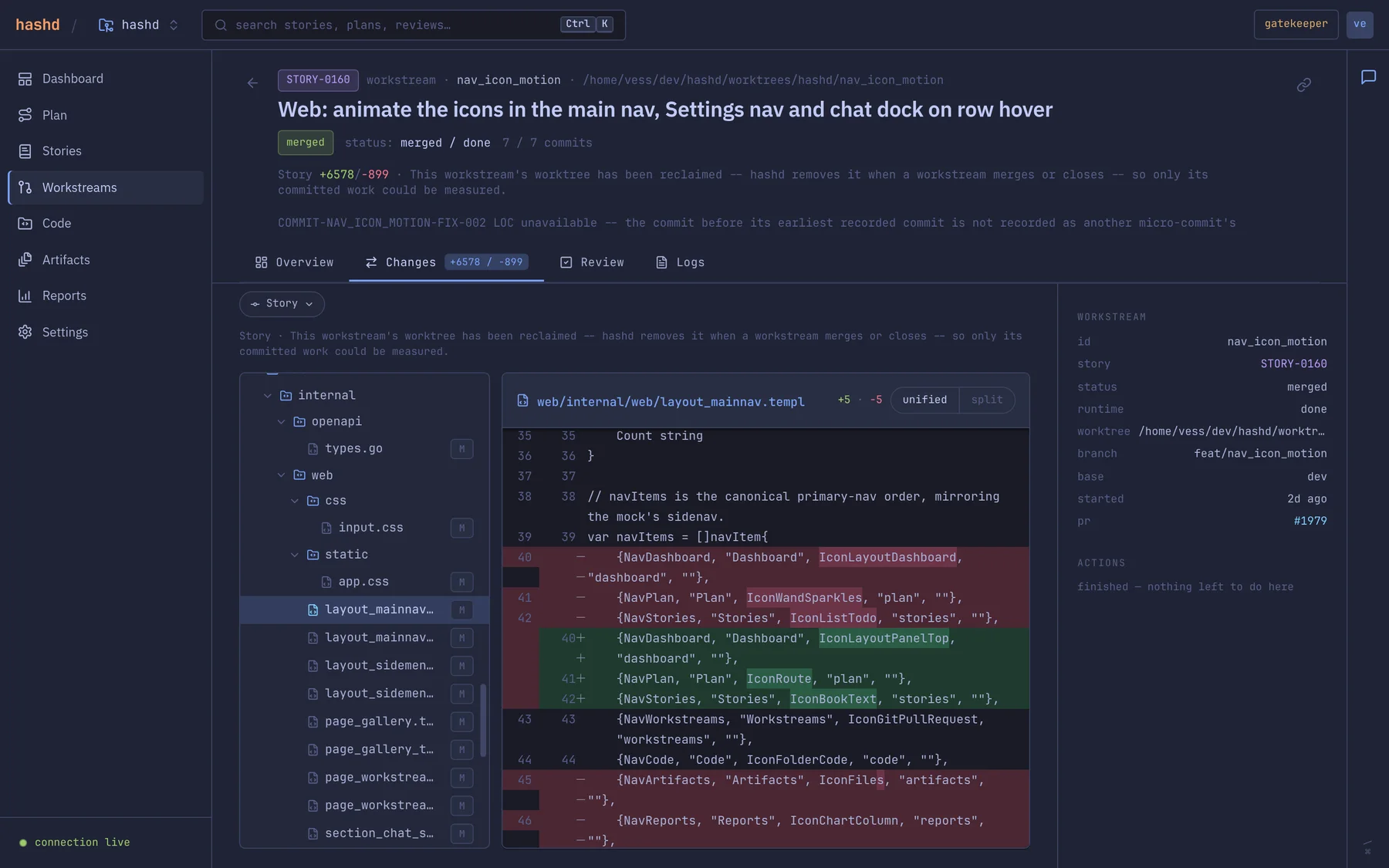
A holistic review of the entire branch diff. It marks the branch ready to merge, flags concerns a person should decide on, or, when you reject, adds a FIX commit that runs through the same gated loop.
Merge gate
Runs your merge-time tests, checks for conflicts against a fresh main and scans for secrets with gitleaks. Merge directly, or through a pull request on GitHub, GitLab, Bitbucket or Gitea. hashd then updates SPEC.md and retires the implemented requirements.
Under the line
Built to keep running.
The machinery that lets a team trust the line with real work.
Parallel workstreams
Many stories run at once, each in its own worktree. A second run of the same workstream is refused, and hashd conflicts reports file overlap between workstreams.
Survives restarts
Long-running work runs as durable Temporal workflows. It survives Ctrl-C and full restarts, and picks up where it left off.
Dual-written events
Every state change is pushed live to every connected surface and written to a durable events table, which is the spine of the audit trail.
Multi-repo projects
A backend, a frontend and an infra repo in one project. Planning happens at the project level; each workstream runs in the right repo.
Grounded in the code
Agents query a pre-computed Context Graph of modules, symbols and dependencies instead of rediscovering the codebase on every run.
Deadlines on every stage
Every agent stage has a timeout and a heartbeat, so a dead worker is caught by a missed heartbeat instead of hanging a workstream.
Put your team's agents on the line.
One command installs hashd and everything it needs except git and a coding agent. Free in solo mode for individuals and teams of up to 10 engineers. Team mode comes with a commercial agreement. Pricing
We work closely with a small group of design partners: hands-on onboarding, a direct line to the people building hashd, and a real say in what we build next.
 by Coderica